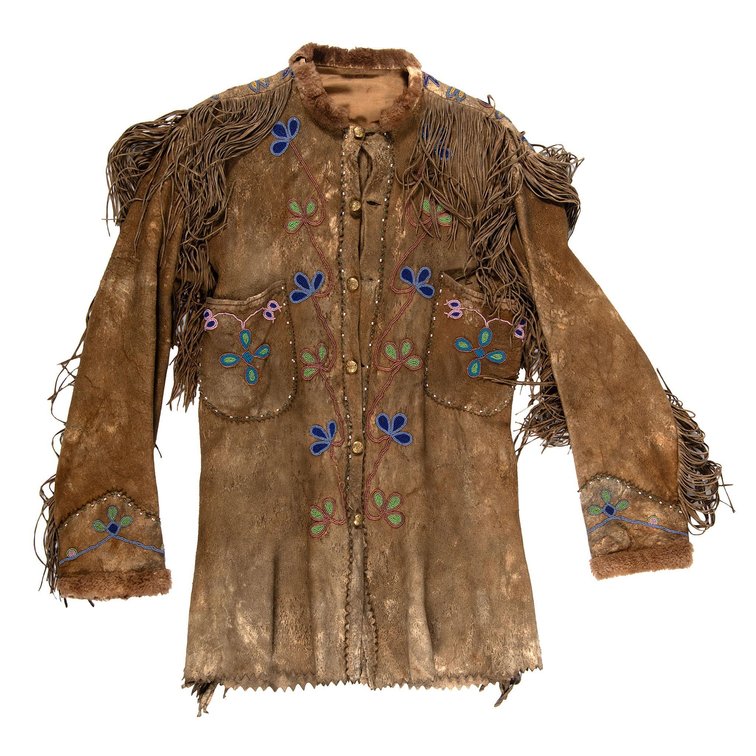
#228 • Edgar Samuel Paxson's Highly Important Rosebud/Little Bighorn Associated Plains Indian Buckskin Coat
Part of The Ray Howser Firearms Collection, 1931-2026 (timed auction by Lewis & Grant Auctions)
Starting at $150,000.00
Status: Available
Live bidding starts Nov 20, 2026 10:00 AM EST
For twenty years, one question consumed Edgar Samuel Paxson: What really happened on that windswept ridge above the Little Bighorn River on June 25, 1876? When news of Lieutenant Colonel George Armstrong Custer’s 7th Cavalry's utter annihilation reached New York, Edgar S. Paxson was a 24-year-old carriage painter. Captivated by the American frontier, Paxson arrived in Montana Territory in 1877. Over the next twenty years, he transformed himself from a stagecoach driver and military scout into one of the nation's premier artists. He never wavered from his ultimate goal, to paint a historically accurate record of "The Last Stand". The resulting 6-by-9-foot oil painting, titled Custer’s Last Stand (completed in 1899), remains an American Icon, the definitive depiction of the battle which left Libby Custer in tears. The Obsession with Absolute Accuracy Unlike the Eastern illustrators who painted the battle from studios in New York or Philadelphia, Paxson lived among the history he sought to capture using his home art studio in Butte, Montana, as the headquarters for a massive, multi-decade research project. Paxson approached creating his monumental canvas like a modern forensic investigator. To reconstruct the chaotic scene, he relied on three distinct pillars of research: Field Research: Paxson physically visited the Little Bighorn battlefield on numerous occasions. He paced the ridges, noted the terrain features, studied the way the harsh Montana sun hit the hills, and mapped out exactly where the bodies of the 7th Cavalry troopers were recovered.Interviews with Eyewitnesses: Paxson interviewed anyone who had a connection to the battle. He spoke extensively with Native American warriors who fought on the ridges including Lakota and Cheyenne fighters, to understand their tactical movements and perspectives. He also tracked down and interviewed the military scouts, officers, and members of the burial parties who arrived at the scene. The Studio Reference Collection: Paxson believed that any painting's historical worth lay in its details of authenticity. He amassed a extensive reference collection of Native American weapons, beaded garments, and frontier tack. When painting a specific rifle, a tacked leather knife sheath, a war club or a piece of cavalry gear he was able to reference the very authentic artifact hanging on his studio wall. Bringing the Battlefield to Life The painting contains over 200 distinct figures, each rendered with portrait-like precision. Paxson successfully captured the chaos of close quarters combat as smoke columns billowed, horses plunged in panic and hand-to-hand struggles dominate the landscape. At the center stands Custer, in his signature fringed buckskin jacket, eyes fixed, swinging a pistol as his officers and brother Tom die at his side. To guarantee ultimate accuracy Paxson corresponded with the families of deceased troopers obtaining photographs and physical descriptions. Legacy of the Canvas Custer’s Last Stand (1899), was met with immediate national acclaim on a highly publicized tour across the United States drawing massive crowds in Chicago, New York, and Washington, D.C. who eagerly paid twenty-five cents to see it. Paxson's masterpiece is the great treasure of the Buffalo Bill Center of the West in Cody, Wyoming after litigation between the states of Montana and Wyoming as to where the iconic painting would reside. The Artifact: A Historic Link to the Battlefield As one examines this highly important, Rosebud and Little Bighorn-associated Plains Indian buckskin coat, it is evident that very few artifacts possess such a direct, unassailable provenance to the battle through one of its earliest and most dedicated researchers. The coat features smoke-tanned buckskin hide tailored in a European style, showcasing structural lapels, a fitted collar, waist pockets, and a U.S. military button-front closure. Heavy fringes line the shoulder seams, complemented by stylized, multi-petaled flowers, buds, and delicate leaf configurations embroidered throughout. This specific Cree-style floral layout uses symmetrical placement across the pockets, cuffs, and lapels—a design that beautifully blends Indigenous artistry with European floral patterns introduced through trade. Paxson acquired this coat through his friendship with tribal leaders and warriors from Blackfoot, Flathead (Salish), Nez Perce and Sioux Nations, who regularly visited his studios in Butte and Missoula. Many of them posed for portraits for their time or as tokens of mutual respect. Paxson frequently traded goods or was gifted authentic regalia, storing these items in his studio as visual reference material. Among his close friends, a relationship well documented in the historical record was the Lakota Sioux Chief Gall. Having fought in both The Battle of Rosebud and The Battle of Little Bighorn. Chief Gall served as Paxson's primary Native American eyewitness during his research for his masterpiece. Paxson was given this Plains Indian Buckskin Jacket with the understanding that it was worn both at The Battle of Rosebud and later at The Battle of Little Bighorn. Paxson treasured this prized piece with near-obsession. He was frequently seen wearing it in his everyday life and wore it continuously while working on the canvas of Custer's Last Stand. Accompanying this extraordinary garment is a notebook from the Paxson family, complete with historic photographs of the artist wearing the jacket in his studio. Paxson's beaded jacket is a treasure of the utmost American cultural and historical significance. Provenance: Tribal Leader Gift to Edgar Samuel Paxson The Paxson Family Ray Howser