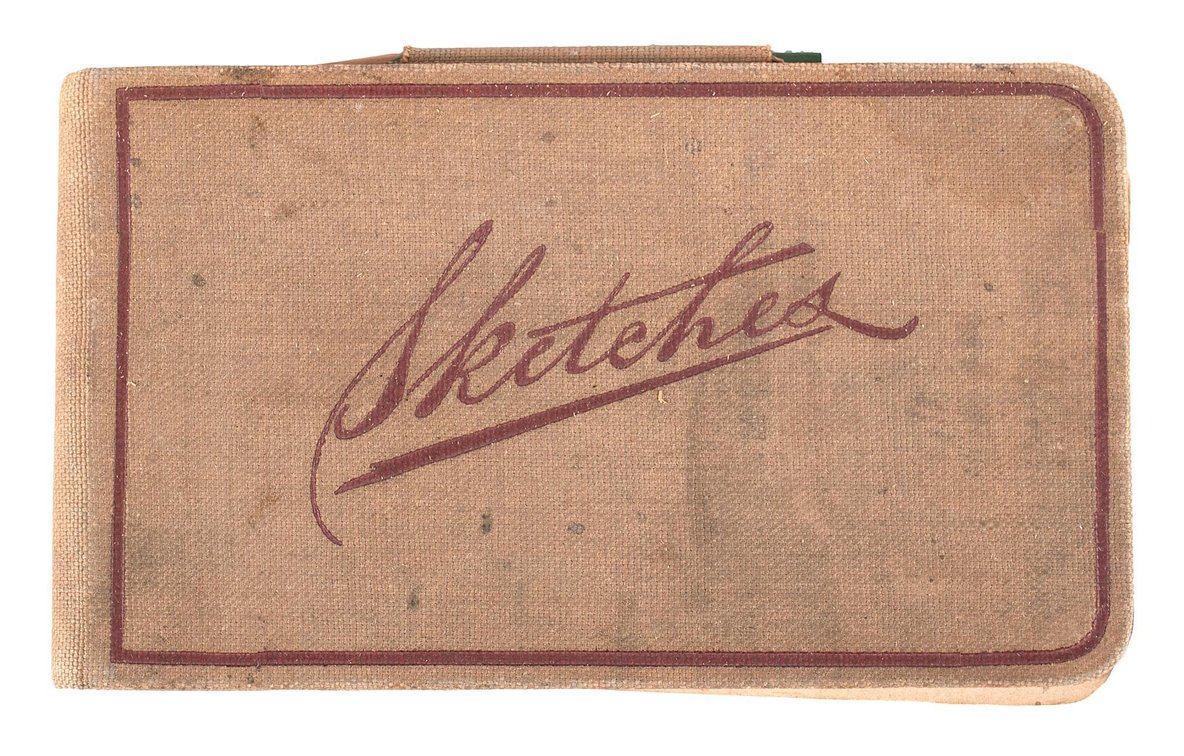
#223 • Edgar Samuel Paxson (American, 1852-1919) Personal Sketchbook Plus
Part of The Ray Howser Firearms Collection, 1931-2026 (timed auction by Lewis & Grant Auctions)
Starting at $500.00
Status: Available
Live bidding starts Nov 20, 2026 10:00 AM EST
This lot includes a single canvas bound sketch book with built in pencil strap and 20 pages, interior cover with hand written note " Jan. 1978. This Edgar S. Pason sketch book has been in the Paxson family possession for some eighty years. Signed William Edgar Paxson (Grandson), all pages are blank with the exception of the final two pages which include 4 total sketchs, including a sketch of a Ranch that titled and signed E.S.P and dated Oct. 19, 1893, a landscape mountain sketch with illegible location which is also signed, a graphite landscape scene which is signed, the last page having a sketch imagery of Shaefer's Billiard Hall, Paxson frequently traveled from Kansas up through Canada and into the Northwest during the late 1870s though the 1880s. He notoriously carried a sketchpad and pencil everywhere he went, using bustling town hubs like Shaefer's to capture the raw, unembellished realism of early American characters before retreating to his Montana studios to translate them into his oil paintings; book is 4 x 7 inches. Good overall condition with staining to the front canvas cover. The final page binding is starting to loosen. Edgar Samuel Paxson (April 25, 1852 – November 9, 1919) was a premier American frontier painter, scout, soldier, and writer who stood alongside his close friend Charles M. Russell as one of Montana's most significant early documentary artists. Immersing himself in the landscape and changing indigenous lifeways of the northern Rocky Mountains, Paxson committed his life to capturing a raw, highly accurate visual record of the historic West. Born to a Quaker family in Orchard Park, New York, Paxson learned fundamental painting techniques from his father, a carriage maker and sign painter. Engulfed with dreams of the frontier, he moved to the Montana Territory in 1877 during the climax of the Nez Perce War. While establishing a life for his family in the mining boomtown of Butte, he supported his fine art ambitions by working commercially as a sign painter and theatrical scenic designer. Paxson fully lived the rugged frontier lifestyle he painted, working at various times as a ranch hand, stagecoach driver, scout, and military dispatch messenger. Throughout all of these dangerous ventures, he constantly carried a sketchbook, capturing the unfiltered reality of the early American West as it unfolded around him. He is best known for his masterpiece, "Custer's Last Battle on the Little Bighorn," a monumental 6-by-9-foot oil on canvas completed in 1899. A dedicated student of the historic 1876 clash, Paxson spent over twenty years meticulously researching the event and interviewing survivors from both sides to ensure an accurate and complete description. Today, this sprawling historic epic is preserved and on display at the Buffalo Bill Center of the West in Cody, Wyoming.