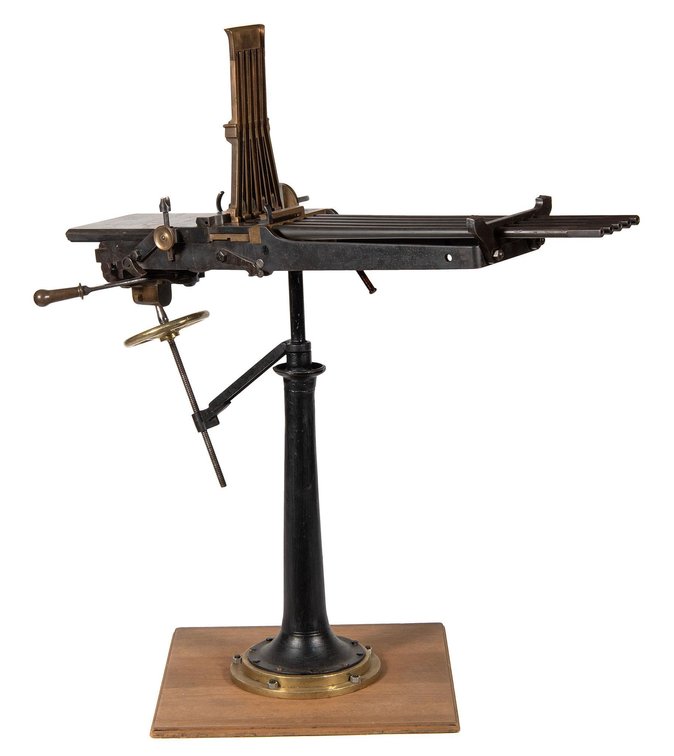
#117 • Rare Nordenfelt Model 1889 Five Barrel Argentine Rapid Fire Gun
Part of The Ray Howser Firearms Collection, 1931-2026 (timed auction by Lewis & Grant Auctions)
Starting at $10,000.00
Status: Available
Live bidding starts Nov 20, 2026 10:00 AM EST
7.65 Argentine caliber, 29.5" round to octagonal barrel length, S/N 1091. The Nordenfelt system was originally designed in 1875 by Helge Palmcrantz, a pioneering Swedish engineer. The manufacturing and international marketing of the weapon were financed by the prominent Swedish banker Thorsten Nordenfelt, from whom the firearm derives its historic namesake. Palmcrantz designed the system to be highly scalable, producing variants ranging from single-barrel configurations up to massive 12-barrel volley weapons. Depending on the barrel count and crew efficiency, the system was capable of achieving a devastating rate of fire between 400 and 1,000 rounds per minute. The Nordenfelt system achieved widespread global adoption, becoming a staple of late-Victorian naval and colonial warfare. Weapons utilizing this mechanism saw extensive combat deployment with the British military, most notably during the bombardment of Alexandria, Egypt, in July 1882, and the First Matabele War in October 1893. Additionally, the Spanish government deployed Nordenfelt multi-barrel guns aboard naval gunboats during the Spanish-American War (1898–1899). This specific specimen represents the Model 1889 "Improved Version," manufactured under an export military contract for the Republic of Argentina. It is chambered for the 7.65x53mm Argentine cartridge. The gun utilizes a proprietary, gravity-fed brass hopper magazine with a 100-round capacity, continuously feeding cartridges down into the action.The weapon secures its breach prior to discharge via a robust, mechanically timed toggle joint locking system. Operation is executed by moving the primary firing lever along a horizontal plane. The five barrels are sequentially numbered 1 through 5. To mitigate excessive simultaneous recoil, the internal firing mechanism trips the firing pins in rapid succession rather than firing as a single volley. This specimen is presented in excellent overall condition, displaying a remarkable degree of preservation for late 19th-century mechanical ordnance. The weapon is entirely original throughout, with the sole exception of a modern wood transit base fabricated exclusively to facilitate movement and display. The factory serial number is clearly stamped and preserved on the original brass hopper magazine, providing critical data for provenance verification.