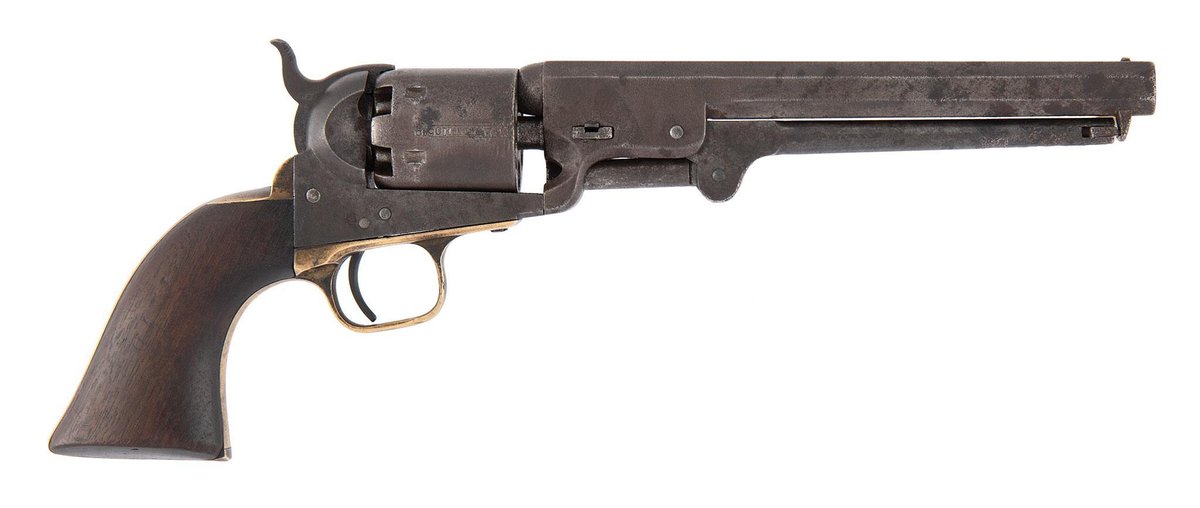
#94 • Rare "Group 2" Colt Model 1851 Navy Inscribed to Confederate "Colonel H.G. Bunn 4th ARK. M.R."
Part of The Ray Howser Firearms Collection, 1931-2026 (timed auction by Lewis & Grant Auctions)
Starting at $5,000.00
Status: Available
Live bidding starts Nov 20, 2026 10:00 AM EST
.36 caliber, 7.5" octagonal barrel length, S/N 110619 (cal 1861). For the discerning Colt or military collector, this Colt Model 1851 Navy represents a pinnacle of rarity. Now documented it stands as one of just 11 known surviving US assembled '51 Navy's with a London address barrel. As described on P. 209 of the "Colt 1851 and 1861 Navies & Conversions" book by Jordan / Geri, the low and high serial numbers for this group of guns is 110,563 - 110,806. The book asserts all the components are US made and Colt was simply using up London barrels for the Civil War. Consistent with Group 2 specifications, the revolver is not engraved, not proofed, and presented without a case. Its exceptional provenance is solidified by an accompanying Colt factory letter, which verifies its inclusion in a historic, 220-gun shipment delivered to Schuyler, Hartley & Graham, also referenced on P. 209. Top of the barrel marked with single line Colt London address. Left side of the frame marked "Colts Patent". All matching numbers. Front bead sight. Case color frame, hammer and lever. Blue barrel with brass back strap and trigger guard. One piece walnut grips. Back strap is inscribed "Col H.G. Bunn 4th ARK M.R.". Good overall condition retaining some of the finish mixing with areas of staining and oxidation that are blending to an overall patina. The brass with a deep mustard patina and the grips show age with nicks and dings. The markings are sharp and crisp. Bore is very good for age with strong rifling. Areas of oxidation in the grooves. Mechanically functional. Portrayed of stern countenance in an old photograph, Henry Gaston Bunn (1838-1908) was characterized by a wartime contemporary as a man of “more than ordinary ability.” H. G. Bunn’s four years of stalwart wartime service foreshadowed métier as the distinguished Chief Justice of the Arkansas Supreme Court (1893-1904). During the war Bunn rose from private soldier to brigade command in Joe Johnston’s skeleton army in North Carolina. With the surrender at Bennett Place of this last significant Confederate army still in the field, Bunn led remnants of his brigade back to Arkansas, and with an eye on the future took up the pursuit of law. With the onset of war, the young college student returned home and briefly joined the 1st Arkansas Mounted Rifles as a private soldier in June 1861. By August he had been elected junior 3rd lieutenant of Company A, 4th Arkansas Infantry, later serving as regimental adjutant. Bunn then fought at the battle of Pea Ridge on March 7-8, 1862 where Earl Van Dorn’s divided Confederate army was soundly defeated due largely to the collapse of Confederate leadership. The battle of Pea Ridge is the battle in which Teas hero General Ben McCulloch was killed by a Northern sharpshooter, Peter Pelican of the 36th Illinois Infantry. Colonel Evander McNair’s 4th Arkansas after action report stated, “Lt. Henry G. Bunn, my adjutant, rendered efficient service during the whole engagement, as and wounded by the explosion of a shell on the head as we were retiring from the field.” Bunn was captured on March 7 but somehow managed to escape and rejoin his regiment. During the siege of Corinth, Mississippi in May 1862, Bunn was promoted to lieutenant colonel (May 8) and with the reorganization of the Confederate army “for the war” was put in command of the freshly raised 31 st Arkansas Infantry. A week later he advanced to colonel on May 15 and returned to the 4th Arkansas Infantry. It is probable that around this time at the earliest - that is to say prior to the advance into Kentucky - Colonel Bunn had the revolver inscribed with his name and regiment. At the battle of Richmond, Kentucky in August 1862, Colonel Bunn led the 4th Arkansas in Kirby Smith’s smashing victory that opened the door to the ensuing “Heartland Offensive.” Victory at Richmond was a nadir moment, one leg of a grand but uncoordinated endeavor that came to naught following Bragg’s pyrrhic victory at the battle of Perryville in October. During the war Arkansas units were chronically understrength – a regiment the size of a company – necessitating multiple and sometimes confusing consolidations. After Bragg’s retreat from Kentucky, the 4th Arkansas absorbed the 4th Arkansas Battalion and the 31 st Arkansas Infantry, the consolidated regiment “involved” at the battle of Jackson, Mississippi according to Crute. The 4th Arkansas was heavily engaged at Murfreesboro between December 31,1862-January 2, 1863, reporting 79 casualties in the wake of Bragg’s controversial decision to withdraw the army to Tullahoma. At Chickamauga in September, the 4th Arkansas went into battle with 385 effectives and lost 24% of those engaged. Bunn’s regiment was actively involved during the see-saw summer campaign to defend the vital workshops and rail terminus at Atlanta. On July 28, 1864, during Hood's rash assault at Ezra Church, Colonel Bunn was seriously wounded, and the brigade incurred 40% casualties. The ferocity of the fighting is amplified by the fact that the commanding officers of all four regiment in the brigade were either killed or wounded. Citing a soldiers’ letter (p.525) in Arkansas Confederates in the Western Theater, the author Willis quoted, “Colonel Bunn, believing he would not survive his wound, gave his [sword and] sword belt to Captain (John W.) Lavender (Co. F), who wanted to keep it safe and decided wearing it would be the best way to accomplish this.” No mention of the pistol is made although officers, of course, typically carried a holstered revolver on the sword belt. Lavender was later captured at the battle of Nashville, and it is noted that the sword belt minus the (hidden) sword went into captivity at Johnson’s Island. Sources are silent on the circumstances of the Bunn’s wound. Colonel Bunn was absent from (Brig. Gen. D.H.) Reynolds Arkansas brigade until sufficiently recovered in February 1865. As the war drifted toward its inevitable closure, Joe Johnston gathered his army at Bentonville, North Carolina in the forlorn hope that combined with the remnants of Lee’s army, the Confederacy still led by Jeff Davis could fight on. During the opening stage of the battle of Bentonville on March 19, 1865, General Reynolds was “wounded by a cannot shot” and carried from the field. Before the major Confederate attack commenced, Colonel Bunn assumed command of the Arkansas brigade. At mid-afternoon, his skirmishers made “first contact” with the enemy. Accompanied by a howling Confederate yell, a bayonet charge went in. Willis wrote, “The yell – described as ‘unearthly’ by one – after many failed attempts to explain the sound satisfactorily – the yell of abandonment and rage, the yell for which the Confederate army in the West was known, was again heard above the sounds of battle for the last time as Reynolds’ (Bunn’s) Arkansans routed the Union defenders from their first line.” Reforming, the small brigade numbering some 200 men, drove the Federals from their second, stronger line and pursued the fleeing enemy “several hundred yards.” The charge resulted in nearly 200 Union prisoners, “more men than Reynolds (Bunn) had in his entire brigade.” Ultimately, General Johnston retreated to Greensboro, North Carolina where General Sherman dictated the final terms of surrender on April 27, 1865. The fifth article allowed “the side arms of officers and their private horses and baggage to be retained by them,” and so, presumably, this pistol bore witness. Henry Gaston Bunn commenced a lifetime practice of law in 1866. As a respected survivor of the burgeoning ‘Lost Cause’ he dabbled in politics while serving as an Arkansas State Senator in 1873-74. In June 1874 he took a seat in the state Constitutional Convention that emphasized states’ rights over the centralized power of the federal government in the post-reconstruction period. He became a judge and later, Chief Justice of the Arkansas Supreme Court at the end of the 19 th century as noted previously. Bunn died on July 17,1908, and was buried in Oakland Cemetery in Camden, Arkansas. Irrevocably tied to the aura of the “Lost Cause,” the former soldier and esteemed jurist was honored by the industrious ladies of the United Daughter of the Confederacy in his last year with the Henry G. Bunn Chapter formed in El Dorado, Arkansas in 1907. In 1909 the chapter dedicated the grand El Dorado Monument on the Union Courthouse lawn to commemorate the service of local soldiers. The assembled crowd sang “Dixie.” The massive monument topped by a bronze statue of a marching Confederate soldier still stands today, having overwhelmingly survived a November 2020 ballot issue (7100 to 4200) to remove the Confederate relic. A large file folder with Colt Factory Letter and research on H.G. Bunn from The Horse Soldier accompanies this great and historic Colt.