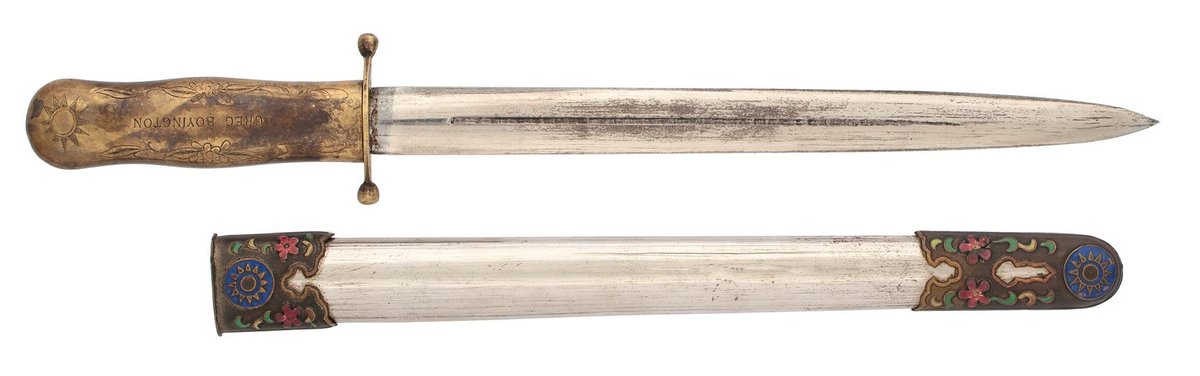
#193 • Commemorative Knife Belonging to Gregory "Pappy" Boyington CMOH, AVG/Marine Flyer
Part of Spring Antique Arms and Armor Auction 2026 (live auction by Lewis & Grant Auctions)
High bid $1,000.00
Status: SOLD
A hefty spear point knife of Asiatic origin - Chinese or Burmese - made with brass hilt inscribed in block lettering "GREG BOYINGTON" on one side and "AMERICAN VOLUNTEER GROUP/CHINA" on the opposite side. The custom made knife measures 15 1/4" OA length with a 9 3/4" plain steel blade. The pommel of the knife and the scabbard share the deeply symbolic 'Blue Sky with a White Sun' emblem of Chiang Kai-shek Nationalist Chinese Government adopted in 1928. The twelve rays of the sun appear on the pommel of the knife representing the passage of time linked to the spirit of indomitable progress. The emblem appears on the top locket and bottom chape of the steel scabbard worked in colorful cloisonné', a traditional Chinese decorating technique employing enamel powder fired at high temperature. The symbol was likewise invocative of Chinese Nationalist political ambition, a unifying beacon in the midst of civil war and Japanese invasion. The legitimacy of the Boyington knife is discussed in an accompanying written "independent laboratory investigative analysis & historical report" undertaken by The War Museum, a specialist in swords and fighting knives. Parenthetically, we have not been able to locate another example of this historic AVG souvenir. Gregory "Pappy" Boyington (1912-1988) was a legendary USMC combat pilot awarded the Medal of Honor for his wartime exploits in 1945. Boyington was an idiosyncratic and combative Marine officer officially credited with destroying 28 Japanese aircraft before being shot down over Rabaul on January 3, 1944. Taken prisoner "by a Japanese submarine crew," he survived nearly 20 months in captivity and returned home in August 1945. Promoted to lieutenant colonel, Boyington was awarded the nation's highest award for gallantry, the Medal of Honor bestowed personally by Harry Truman on October 4, 1945. Boyington retired from the Marine Corps as a bird colonel in 1947 and would write his autobiography, Baa Baa Black Sheep, published in 1958. As late as 1976 "Pappy's" exploits were loosely retold in the network TV "Baa Baa Black Sheep" starring Robert Conrad. Boyington's military service had begun in 1935 with an ROTC commission in the Army coast artillery. He later transferred to the Marine Corps in 1936 and accepted an appointment as an aviation cadet. While serving as a Marine flight instructor at Pensacola Naval Air Station in 1941, he volunteered to fly for Nationalist China with a civilian company that later morphed into the famed American Volunteer Group (AVG) commanded by Claire Chennault. First Lieutenant Boyington resigned his commission in August 1941 and joined the Flying Tigers tasked by Chiang Kai-shek with defending the vital supply artery known as the Burma Road. He saw combat against the Japanese as a flight leader and claimed to have shot down 6 enemy aircraft, a claim later endorsed by the Marine Corps, although AVG records credit him with just 3 1/2. Boyington's time with the Flying Tigers lasted a short 8 months, and the interlude was not without controversy. According to a modern biographer, the turbulent Boyington butted heads with Chennault and was not well received by a number of his fellow AVG pilots. In the wake of Pearl Harbor, Boyington broke his contract with the AVG in April 1942 and returned home to resume flying with the Marine Corps in the Pacific, a stubborn and independent pilot who crafted a heroic and colorful tale on the way to the Medal of Honor.